Elephants Environment
CHARACTERISTICS。
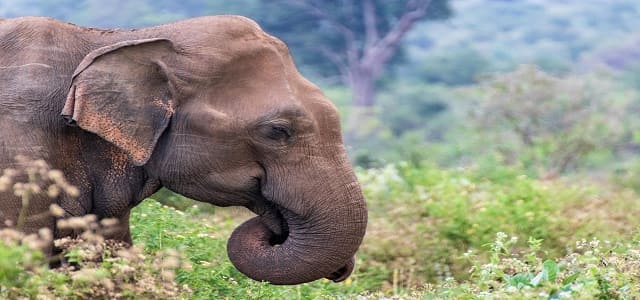
 In general, Asian elephants are smaller than African elephants and have the highest body point on the head. The tip of their trunk has one finger-like process. Their back is convex or level. Females are usually smaller than males. 90% of tuskless males are called makhnas. Some males have tusks.[3]
Sri Lankan elephants are the largest subspecies reaching a shoulder height of between 2 and 3.5 m (6.6 and 11.5 ft), weigh between 2,000 and 5,500 kg (4,400 and 12,100 lb), and have 19 pairs of ribs. Their skin colour is darker than of indicus and of sumatranus with larger and more distinct patches of depigmentation on ears, face, trunk and belly.[4] Only 7% of males bear tusks. Average adult elephant tusks grow up to about 6 feet. It can weight up to 35 kg (77 lb).[5] Longest tusks of 7 feet 6 inches long was found in Millangoda Raja (1938-30 July 2011).[6][7]
The Sri Lankan subspecies designation is weakly supported by analysis of allozyme loci,[8] but not by analysis of mitochondrial DNA (mtDNA) sequences.[9][10][11]
In July 2013, a dwarf Sri Lankan elephant was sighted in Udawalawe National Park. It was over 1.5 m (5 ft) tall but had shorter legs than usual and was the main aggressor in an encounter with a younger bull.[12]
In general, Asian elephants are smaller than African elephants and have the highest body point on the head. The tip of their trunk has one finger-like process. Their back is convex or level. Females are usually smaller than males. 90% of tuskless males are called makhnas. Some males have tusks.[3]
Sri Lankan elephants are the largest subspecies reaching a shoulder height of between 2 and 3.5 m (6.6 and 11.5 ft), weigh between 2,000 and 5,500 kg (4,400 and 12,100 lb), and have 19 pairs of ribs. Their skin colour is darker than of indicus and of sumatranus with larger and more distinct patches of depigmentation on ears, face, trunk and belly.[4] Only 7% of males bear tusks. Average adult elephant tusks grow up to about 6 feet. It can weight up to 35 kg (77 lb).[5] Longest tusks of 7 feet 6 inches long was found in Millangoda Raja (1938-30 July 2011).[6][7]
The Sri Lankan subspecies designation is weakly supported by analysis of allozyme loci,[8] but not by analysis of mitochondrial DNA (mtDNA) sequences.[9][10][11]
In July 2013, a dwarf Sri Lankan elephant was sighted in Udawalawe National Park. It was over 1.5 m (5 ft) tall but had shorter legs than usual and was the main aggressor in an encounter with a younger bull.[12]