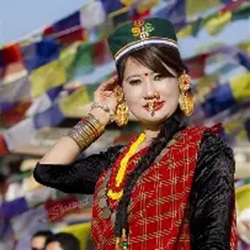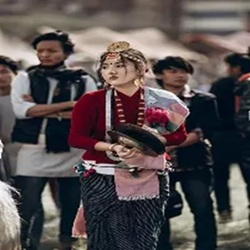
The Nepalese caste system is the traditional system of social stratification of Nepal. The Nepalese caste system broadly borrows the classical Hindu Chaturvarnashram model, consisting of four broad social classes or varna: Brahmin, Kshatriya, Vaishya, Sudra. The caste system defines social classes by a number of hierarchical endogamous groups often termed jaat. This custom was traditionally only prevalent in the three Indo Aryan societies of the Khas, Madhesi, and Newars. However, since the unification of Nepal in the 18th century, Nepal's various non-Hindu ethnic nationalities and tribes, previously called "Matwalis" (alcohol-drinkers) and now termed as "Adivasi/Janajati" (indigenous/nationalities), have been incorporated within the caste hierarchy to varying degrees of success. Despite the forceful integration by the state into the pan-Hindu social structure, the traditionally non-Hindu groups and tribes do not necessarily adhere to the customs and practices of the caste system.[1] The Government of Nepal legally abolished and criminalized any caste-based discrimination, including "untouchability" (the ostracism of a specific caste) - in 1963.[2] With Nepal's step towards freedom and equality, Nepal, previously ruled by a Hindu monarchy, was a Hindu nation which has now become a secular state.[3] On 28 May 2008, it was declared a republic,[4] ending the period of the Hindu kingdom of Nepal.[5] History

The Rai (Kirati: also known as Jimee or Khambu, Rāi; Devanagari: राई) are an ethnolinguistic group belonging to the Kirat family and primarily Sino-Tibetan linguistic ethnicity.[8] They are indigenous to the eastern parts of Nepal, the Indian states of Sikkim, West Bengal (predominantly Darjeeling and Kalimpong Hills) and in southwestern Bhutan.[9][10] The Rai, as a set of groups, are one of the oldest tribes of Nepal. They inhabited the area between the Dudh Koshi and Tamur River in Nepal.[11].[12] Rai are also known as "Khambu" in some places. They are known for worshipping nature and ancestral spirits. Rai are one of the tribes of the Kirati group. They are popularly believed to have offered a stiff resistance to the invasion of the Gorkhas.[13] Kiranti Rai are hill tribes who once possessed considerable power and territory but were reduced to submission by Prithvi Narayan Shah after his conquest of Nepal.[14] Kirati rule in the eastern hills of Nepal ended after the conquest of the Gorkha Kingdom in

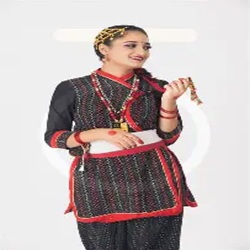
The Magars, also spelled Mangar and Mongar, are the largest ethnic group native to Nepal and Northeast India, representing 6.9% of Nepal's total population according to the 2021 Nepal census.[1] They are one of the main Gurkha tribes. Magar girls of Nepal The first home of the Magars was to the west of the Gandaki River and, roughly speaking, consisted of that portion of Nepal which lies between and around about Gulmi, Arghakhanchi, and Palpa.[2] This part of the country was divided into twelve districts known as Bahra Magarat (Confederation of Twelve Magar villages), which included the following regions of that period: Argha, Khanchi, Bhirkot, Dhor, Garhung, Ghiring, Gulmi, Isma, Musikot, Rising, Satung, and Pyung.[2] During the medieval period, the whole area from Palpa to Rukum Rolpa was called the Magarat, a place settled and inhabited by Magars.[3] Another confederation of eighteen Magar kingdoms, known as Athara Magarat, also existed and was originally inhabited by Kham Magars.

Newar caste system is the system by which Newārs, the historical inhabitants of Kathmandu Valley, are divided into groups on the basis of Vedic varna model and divided according to their hereditary occupations. First introduced at the time of the Licchavis (A.D. 300 – c. 879), the Newar caste system assumed its present shape during the medieval Malla period (A.D. 1201–1769).[1] The Newar caste structure resembles more closely to North India and Madheshis than that of the Khas 'Parbatiyas' in that all four Varna (Brahmin, Kshatriya, Vaishya and Shudra) and untouchables are represented.[2] The social structure of Newars is unique as it is the last remaining example of a pre-Islamic North Indic civilisation in which Buddhist elements enjoy equal status with the Brahmanic elements.[3]

The Tamang people (རྟ་དམག་; Devanagari: तामाङ; tāmāṅ) are an ethnic group living in Nepal, Northeast India and southern Bhutan. In Nepal, they are concentrated in the central hilly and Himalayan regions[5] and constituted over 1.6 million people in the 2021 census.[1] In India, Tamang people live in the state of Sikkim, in the Darjeeling and Kalimpong districts of West Bengal and in Assam. In Bhutan, they live foremost in the southern foothills including Tsirang District, Dagana District, Samtse District, Chukha District, Sarpang District and Samdrup Jongkhar District.The Tamang language is the fifth most-spoken language in Nepal.[7] History